What if Lasik screws up? Get a retinal implant
Filed Under Body Modification, News on 2008-03-12, 15:57
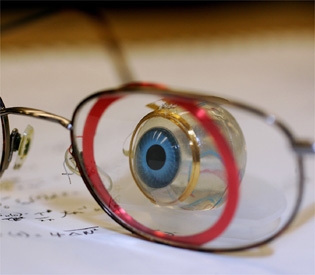
The number one question in my mind that deters me from laser eye surgery to correct my vision is “what if the doctor screws up and I’m blind?” My sight is an important part of my life, as it is for most people, and I can’t imagine trying to function in life without it. I’ve joked in the past that I’ll get lasik when they have replacements on hand in case something goes wrong. Well, now they will. It has taken them 20 years, but the Boston Retinal Implant Project has designed an implant that will “provide patients with a sense of their surroundings – to detect shapes and obstacles in their pathways”. It’s not a perfect replacement for your natural eyesight yet, but it will allow you to get around on your own without a guide dog or a white cane. Most of the hardware is kept outside of the eye, with only a small strip of plastic actually implanted. This plus the reports that LASIK can improve eyesight beyond 20/20 continue to make the procedure more attractive to me. If you want to check out more info on the retinal implant, there’s a good article on The Boston Herald with more details on how it was designed.
Comments
13 Responses to “What if Lasik screws up? Get a retinal implant”
Leave a Reply
-
Subscribe

Subscribe to my feed -
Twitter
-
My Other Stuff
-
Find It
-
Sites I Like
-
Archives
- August 2014
- May 2014
- April 2014
- February 2014
- November 2013
- October 2013
- September 2013
- July 2013
- June 2013
- May 2013
- January 2013
- September 2012
- August 2012
- July 2012
- May 2012
- March 2012
- February 2012
- September 2011
- June 2011
- May 2011
- March 2011
- December 2010
- June 2010
- April 2010
- March 2010
- February 2010
- January 2010
- December 2009
- November 2009
- October 2009
- September 2009
- August 2009
- July 2009
- June 2009
- May 2009
- April 2009
- March 2009
- February 2009
- January 2009
- December 2008
- November 2008
- October 2008
- September 2008
- August 2008
- July 2008
- June 2008
- May 2008
- April 2008
- March 2008
- February 2008
- January 2008
- December 2007
- November 2007
- October 2007
- September 2007
- August 2007
- July 2007
- June 2007
- May 2007
- April 2007
- March 2007
- February 2007
- November 2006
- October 2006
Geeked.info
If LASIK goes wrong, 99% of the time it’s the cornea that’s damaged, not the retina. Don’t ever consider LASIK — it’s an inherently harmful surgery, even though it can correct refractive errors. Complications after LASIK are common. I have researched LASIK risks and complications extensively. My website contains many excerpts from medical studies that show an alarming percentage of patients suffer dry eyes and night vision impairment. Furthermore, medical studies have proven that the flap only heals to 2% of the cornea’s original tensile strength, and that the biomechanical strength of the cornea is permanently reduced by about 50% in all LASIK patients. Corneal nerves are severed when the flap is cut and never fully return to normal densities and patterns. You can read more about LASIK complications on my website:
http://www.lasikcomplications.com
If LASIK goes wrong, 99% of the time it's the cornea that's damaged, not the retina. Don't ever consider LASIK — it's an inherently harmful surgery, even though it can correct refractive errors. Complications after LASIK are common. I have researched LASIK risks and complications extensively. My website contains many excerpts from medical studies that show an alarming percentage of patients suffer dry eyes and night vision impairment. Furthermore, medical studies have proven that the flap only heals to 2% of the cornea's original tensile strength, and that the biomechanical strength of the cornea is permanently reduced by about 50% in all LASIK patients. Corneal nerves are severed when the flap is cut and never fully return to normal densities and patterns. You can read more about LASIK complications on my website:
http://www.lasikcomplications.com
Lasik changes the shape of the cornea (clear front) of the eye. The laser energy does not affect the retina, which is the light sensitive membrane inside and at the back of the eye.
I work for a nonprofit Lasik patient advocacy. We do not provide Lasik. We provide Lasik information and certify Lasik doctors who meet patient outcome requirements.
Many studies have shown that Lasik is safe and effective by medical standards. A recent evaluation of studies involving over 2,000 patients found a Lasik
satisfaction rate of about 95%. Satisfaction may not be perfection, but it is satisfaction.
Lasik is surgery and all surgery has risks, but risk to the retinal is highly improbable.
Glenn Hagele
Council for Refractive Surgery Quality Assurance
http://www.USAEyes.org
Lasik changes the shape of the cornea (clear front) of the eye. The laser energy does not affect the retina, which is the light sensitive membrane inside and at the back of the eye.
I work for a nonprofit Lasik patient advocacy. We do not provide Lasik. We provide Lasik information and certify Lasik doctors who meet patient outcome requirements.
Many studies have shown that Lasik is safe and effective by medical standards. A recent evaluation of studies involving over 2,000 patients found a Lasik
satisfaction rate of about 95%. Satisfaction may not be perfection, but it is satisfaction.
Lasik is surgery and all surgery has risks, but risk to the retinal is highly improbable.
Glenn Hagele
Council for Refractive Surgery Quality Assurance
http://www.USAEyes.org
Since my previous post, our organizaion presented the USAEyes Competence Opinion Relative to Expectation (CORE) patient survey to the US Food and Drug Administration Ophthalmic Devices Panel. Based upon the patients who responded:
99% report quality of life as expected, better, or much better after vision correction surgery
98% state day vision as expected, better, or much better
98% report no complications or complications that are seldom problematic
98% would recommend surgery to family and friends.
97% would have surgery again, knowing what they know now
96% wear corrective lenses as often as expected, less than expected, or much less than expected
96% report postop vision without lenses as expected, better, or much better than expected when compared to preop vision with lenses
96% report overall quality of vision as expected, better, or much better than expected
91% report no complications at any time
91% state night vision as expected, better, or much better than expected
7% report complications seldom problematic, however 91% of these same patients would have surgery again
2% report complications frequently or always problematic, however 22% of these same patients would have surgery again
The full survey is available at the FDA's website at http://tinyurl.com/6492rv
Glenn Hagele
Council for Refractive Surgery Quality Assurance
http://www.USAEyes.org
had sugery 3 months ago big mistake lots of complications eyesight now very bad when trying to read and long distance deteriorating
@clive – So sorry to hear that. Generally lasik is safe, but there can be complications
i am planning to undergo lasik surgery ff course it wasn’t any easy choice especially when I get a lot of objections however got plenty of encouragement from quite a few number of my colleagues who went and completed this procedure with no issues.
i am planning to undergo lasik surgery ff course it wasn’t any easy choice especially when I get a lot of objections however got plenty of encouragement from quite a few number of my colleagues who went and completed this procedure with no issues.
Lasik and PRK are surgeries that eventually will blind. Many people have night vision problems. Very little is known about light in terms at the quantum level. Different photons hit different part of the retina
after Lasik. Causing blur. The area hit in the butchery is damaged tremendously by the Laser. Nothing heals the same. Lasik should be banned.
One of the scariest article……i am having pain in my eyes now……..but nevertheless good post!!!!
Laser eye surgery
Extremely helpful, I will
definately be returning because i begin my subsequent taskdiscount uggsuggs discountdiscount uggs bootsugg boots saleugg boots for salesale ugg bootsUggs australiaUgg australia outletUgg australia boots
Moncler è il marchio più famoso d’inverno in questo mondo, Piumini Moncler nel mondo della moda è più popolare di altri marchi, e rende possibile per ogni uomo e donna di guardare a caldo su un weather.In molto freddo il nostro sito possiamo permetterci tutti i tipi di Moncler Donna e Uomo Moncler, credo fermamente che si può prendere agli occhi degli altri con la giacca Moncler state portando alla moment.Creativity e innovazione è il motivo per questo marchio è molto attractive.And il materiale di Moncler è tutto all’acqua calda, così che tipo di freddo in questo inverno, non abbiate paura, perché si ha un perfetto Moncler Piumini, che è il point.And nostro sito sono Moncler sito Ufficiale, e lo prendiamo dalla fabbrica, quindi il prezzo è incredibile a buon mercato, in modo da visita Piumini Moncler online, acquistare il necessario in inverno.